
Chemical Burns of the Eye
Curriculum lesson · updated 2026-07-29
Pending review from section expertOn this page
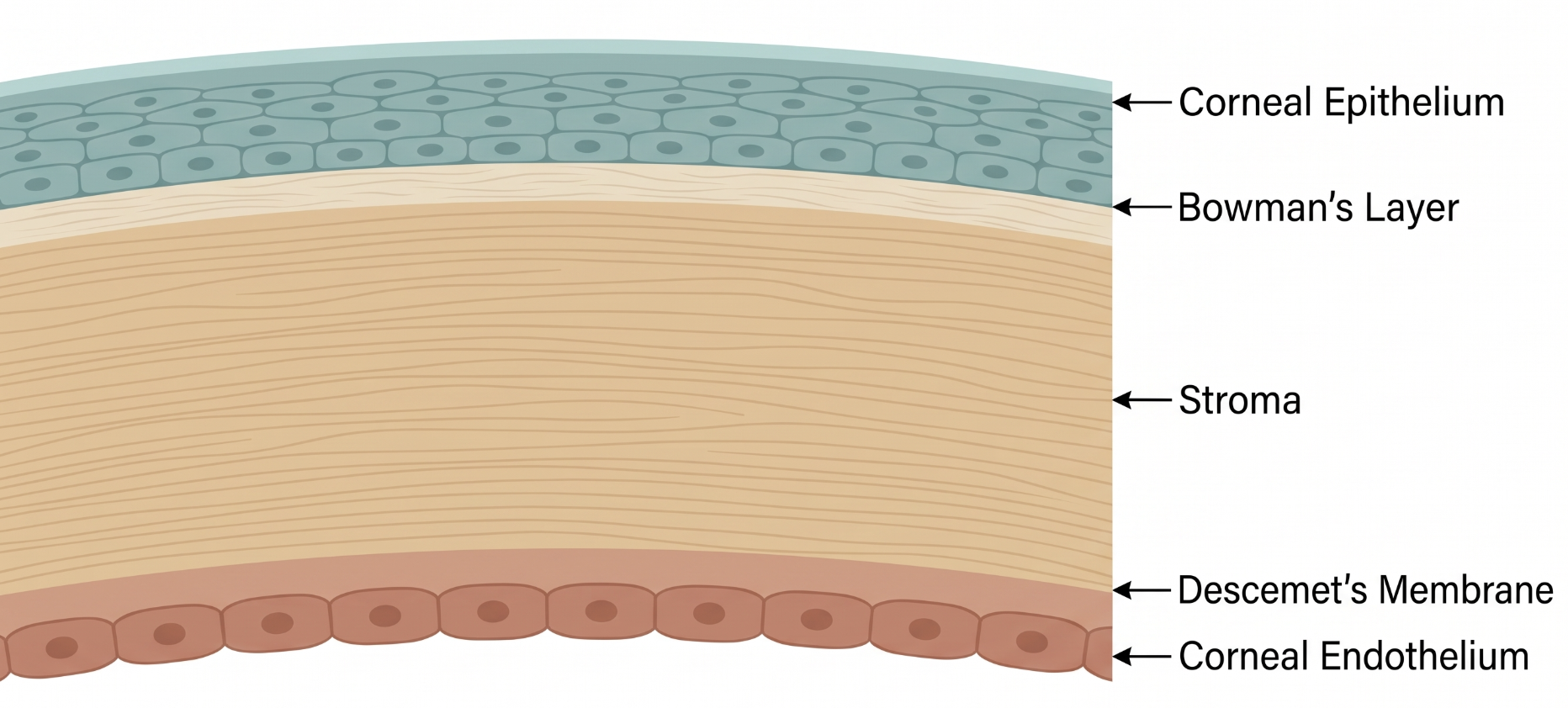
The limbus houses the stem cell population responsible for continuously regenerating corneal epithelium throughout life, supplied by a ring of perilimbal blood vessels. Ocular chemical burns are true emergencies because, beyond the visible corneal damage, they can destroy this limbal stem cell niche and its vascular supply — the single most important factor determining whether the eye can ever successfully re-epithelialize.1
Alkali agents (ammonia, sodium hydroxide, lime) cause liquefactive necrosis via saponification of cell membrane lipids, allowing rapid, deep penetration through the cornea into the anterior chamber and beyond — damaging the stroma, endothelium, intraocular structures, and critically, the limbal stem cell niche. Acid agents instead cause coagulative necrosis, in which denatured protein forms a barrier limiting further penetration, generally producing more self-limited (though occasionally still severe) injury. Limbal ischemia — from damage to the vasculature supplying the limbal stem cell niche — is the single most important pathological feature determining ultimate prognosis.
Patients present with acute pain, photophobia, blepharospasm, and decreased vision following a known chemical exposure. A clear exposure history (agent, concentration, contact duration) should be obtained, though treatment must never be delayed for history-taking.
Differential diagnosis includes thermal ocular burns, UV/radiation keratopathy, and severe allergic or toxic conjunctivitis (far less severe, distinguishable by the absence of an exposure history and lack of limbal ischemia).
Two classification systems grade severity and guide prognosis based on corneal clarity and the extent of limbal (perilimbal) ischemia2:
- Roper-Hall classification (grades I-IV): grade I (epithelial damage only, no limbal ischemia — excellent prognosis) through grade IV (opaque cornea obscuring the iris/pupil, more than half of the limbus ischemic — very poor prognosis)
- Dua classification: refines this by quantifying limbal involvement in clock hours and adding conjunctival involvement, which some evidence suggests better predicts final visual outcome than Roper-Hall alone2
Conjunctival blanching is a sign of ischemia, not a reassuring finding — it should not be mistaken for a mild injury.
Immediate management, before any other assessment including visual acuity, is copious irrigation with the most readily available neutral solution for at least 15-30 minutes, checking pH periodically until it normalizes and remains stable.1 Sweeping the fornices to remove retained particulate matter (e.g., lime) is essential, since retained material continues to cause injury. Amphoteric, hypertonic chelating solutions (e.g., Diphoterine) have been proposed as superior alternatives to plain water, neutralizing agents more rapidly without generating heat, though adoption remains limited.3
Subsequent management depends on severity: topical antibiotics, cycloplegia, aggressive lubrication, and cautious topical corticosteroids (balanced against corneal melting risk with prolonged use). Elevated intraocular pressure is common acutely and should be checked and treated.
For severe injuries with limbal stem cell loss (Roper-Hall grade IV / Dua grade IV-VI), amniotic membrane transplantation is used early, though these injuries — especially assault-related ammonia burns — frequently progress to total limbal stem cell deficiency despite treatment.2 Tertiary referral should be considered for limbal stem cell failure or vision-limiting scarring.1
- Irrigation must begin immediately, before visual acuity testing or any other assessment — the single highest-yield intervention in ocular chemical burns
- Alkali burns are generally more severe than acid burns because saponification allows rapid, deep tissue penetration
- Limbal ischemia, not just corneal clarity, is the key prognostic feature
- Grade IV injuries, particularly assault with ammonia, carry a very high risk of progressing to total limbal stem cell deficiency despite optimal treatment
- Common pitfall: delaying irrigation to check visual acuity, take a full history, or obtain imaging — irrigation always comes first
Ocular Chemical Burn: The First 30 Minutes
Clinical Skills for This Topic
Emergency ocular irrigation technique
Know how to set up continuous irrigation (e.g., IV tubing over the bridge of the nose, Morgan lens) and how to check pH with litmus paper in the fornix.
Fornix sweeping for retained particulate matter
Use a moistened cotton-tip applicator to sweep the upper and lower fornices, especially after exposure to particulate alkali agents like lime.
Grading limbal ischemia at the slit lamp →
Assess the extent (in clock hours) of perilimbal blanching/ischemia versus normal perfusion, central to both the Roper-Hall and Dua classification systems.
Practice Questions
Question 1 of 6
Score: 0/0
What is the single most important first step in managing a patient with a chemical eye splash?
Saved in this browser.
References
- [1]Bizrah M, et al. An update on chemical eye burns. Eye. 2019.
- [2]Ghosh S, et al. Acute Chemical Eye Injury and Limbal Stem Cell Deficiency—A Prospective Study in the United Kingdom. Cornea. 2019.
- [3]Lewis CJ, et al. Is it time for a change in the approach to chemical burns? The role of Diphoterine in the management of cutaneous and ocular chemical injuries. Journal of Plastic, Reconstructive & Aesthetic Surgery. 2017.